Oyetola Urges Judiciary to Brace for Autonomous Ships, Digital Shipping Disputes
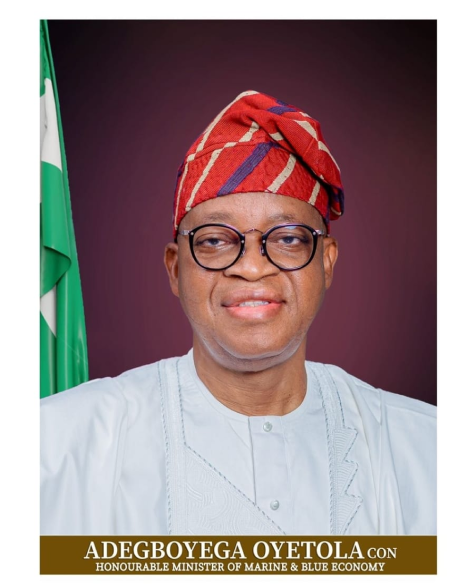
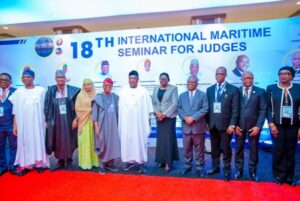
Executive Secretary/CEO of Nigerian Shippers’ Council (NSC), Dr. Pius Akutah; Deputy Chief Whip of the House of Representatives, Hon. Ibrahim Ayokunle Isiaka; Chairman of NSC Governing Board, Dr. Ibrahim Shehu Shema; Permanent Secretary, Federal Ministry of Marine and Blue Economy, Mrs. Fatima Mahmood; Minister of Marine and Blue Economy, Dr. Adegboyega Oyetola; Secretary to the Government of the Federation, Senator George Akume; Chief Justice of Nigeria, Justice Kudirat Kekere-Ekun, and other dignitaries at the 18th International Maritime Seminar for Judges organised by the Nigerian Shippers’ Council and the National Judicial Institute in Abuja, on Wednesday.
BY FRONTLINE REPORTERS
The Minister of Marine and Blue Economy, Dr. Adegboyega Oyetola, has called on Nigeria’s judiciary to prepare for an emerging wave of complex maritime disputes stemming from autonomous vessels, digital shipping systems and the global shift toward cleaner maritime transportation.
Oyetola made the call on Wednesday while delivering the keynote address at the opening of the 18th International Maritime Seminar for Judges, jointly organised by the Nigerian Shippers’ Council (NSC) and the National Judicial Institute (NJI) in Abuja.
The event drew an array of distinguished personalities, including the Chief Justice of Nigeria, Justice Kudirat Kekere-Ekun; Secretary to the Government of the Federation, Senator George Akume; Permanent Secretary, Federal Ministry of Marine and Blue Economy, Mrs. Fatima Mahmood; Chairman of the NSC Governing Board, Dr. Ibrahim Shehu Shema; Deputy Chief Whip of the House of Representatives, Hon. Ibrahim Ayokunle Isiaka; and the Executive Secretary/CEO of the Nigerian Shippers’ Council, Dr. Pius Akutah.
The Minister warned that the rapid advancement of maritime technology is ushering in unprecedented legal challenges that will demand a more informed and technologically aware judiciary.
According to him, the emergence of autonomous ships operating with limited or no human crews raises fundamental questions relating to liability, navigational responsibility, insurance claims, collision regulations and accountability when onboard systems or technologies fail.
“The prospect of vessels operating with limited or no human crews raises fundamental questions concerning liability, navigational responsibility, insurance, collision regulations, and the allocation of legal responsibility when technology fails,” Oyetola stated.
He further noted that the increasing digitalisation of global shipping—through electronic bills of lading, blockchain-enabled cargo documentation and digital freight contracts—is revolutionising maritime commerce while simultaneously creating fresh evidentiary, contractual and jurisdictional concerns for courts across the world.

Beyond technological advancements, Oyetola said the maritime sector’s growing commitment to decarbonisation and environmental sustainability would inevitably lead to more intricate legal disputes involving pollution damage, environmental liability, regulatory enforcement and compliance with evolving international standards.
He urged judges to equip themselves with not only sound legal reasoning but also a strong appreciation of scientific developments and emerging international jurisprudence to effectively adjudicate such matters.
The Minister stressed that an efficient and predictable dispute resolution system remains critical to Nigeria’s ambition of becoming Africa’s leading maritime hub.
He observed that every maritime judgment delivered by Nigerian courts resonates far beyond the parties involved, influencing global perceptions of the country’s investment climate.
“Every judgment delivered in a maritime matter sends a powerful message—not only to the litigants before the court, but also to international investors, shipowners, financiers, insurers, cargo interests and seafarers across the world,” he said.
“A predictable, well-reasoned and internationally informed judiciary is itself an instrument of economic competitiveness. It lowers transaction costs, enhances commercial confidence, encourages parties to choose Nigerian courts and arbitration centres for the resolution of maritime disputes, and reinforces Nigeria’s reputation as a credible destination for maritime investment.”
Oyetola’s remarks underscore the critical role of the judiciary in shaping the future of Nigeria’s maritime sector at a time when technological innovation, digital transformation and environmental imperatives are redefining global shipping operations.
The annual International Maritime Seminar for Judges has become a strategic platform for fostering collaboration between the maritime industry and the judiciary, with stakeholders emphasizing that a knowledgeable and responsive legal system will be indispensable in navigating the challenges and opportunities of the evolving blue economy.
ADVERTISEMENTS