Customs AEO Scheme Slashes Cargo Clearance to 8 Hours

– Clearance time drops from 156 hours to 43 as compliant importers reap fast-track benefits
By Frontline Reporters
The Authorised Economic Operator (AEO) scheme of the Nigeria Customs Service has recorded a major breakthrough in cargo clearance, cutting the average processing time at Nigerian ports from 156 hours to 43 hours, with some top-tier compliant importers now securing cargo release in as little as eight hours.
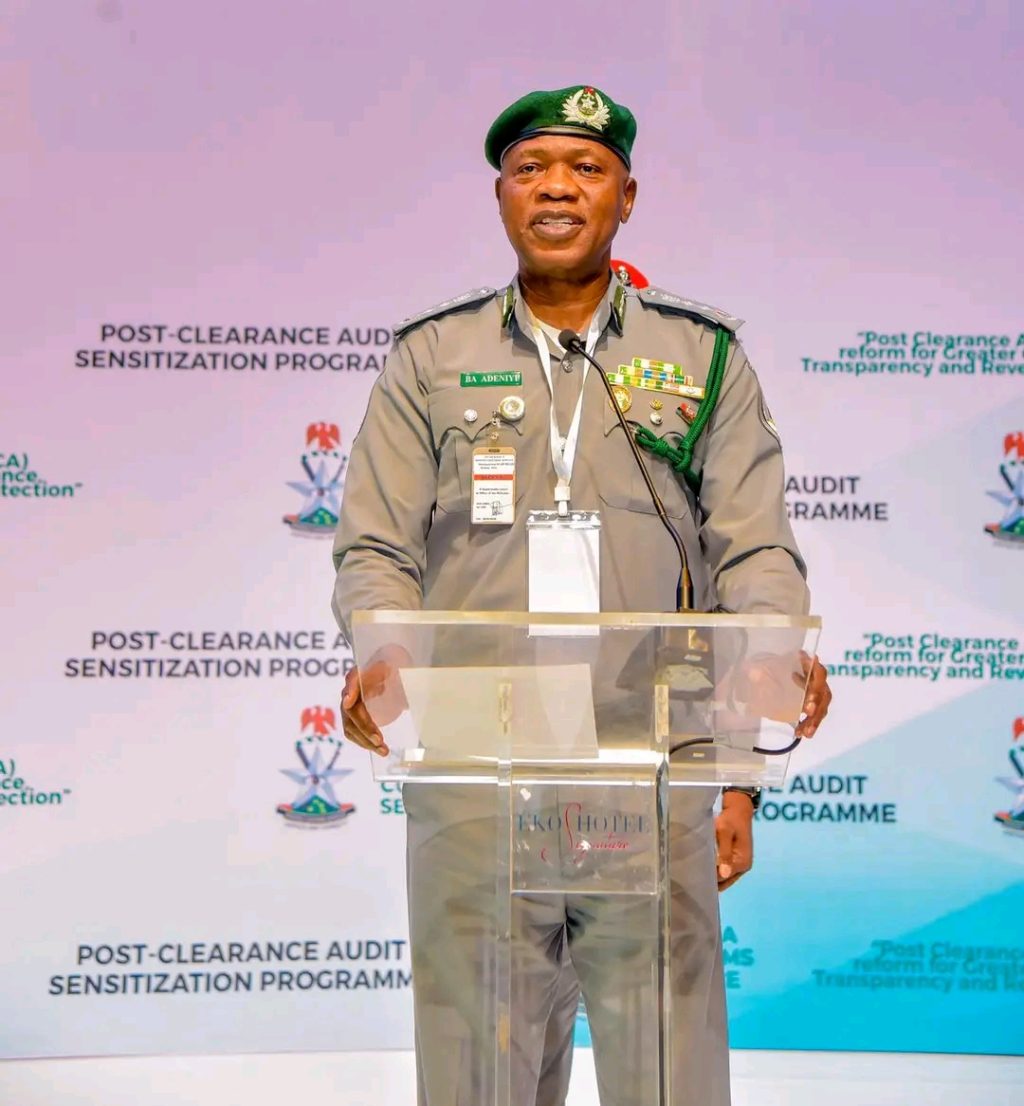
The Comptroller-General of Customs, Adewale Adeniyi, disclosed this on Thursday, September 10, 2026, at a Post-Clearance Audit (PCA) sensitisation exercise in Lagos, where he revealed that 247 companies had so far been admitted into the modernised AEO framework.
According to Adeniyi, the dramatic improvement in clearance time is largely attributable to the quality of documentation, compliance standards and operational discipline demonstrated by companies participating in the scheme.
“Before we started AEO, companies used to have an average of 156 hours in terms of clearance time. But now, it has been reduced to 43 hours. In fact, one of them has achieved an eight-hour clearance time because of the quality of their documentation,” he said.
The Customs chief said the development was consistent with the Federal Government’s broader efforts to reduce the cost of doing business, eliminate bottlenecks at the nation’s ports and strengthen non-oil revenue generation.
From Port Policing to Trusted Partnership
Adeniyi explained that the AEO programme is anchored on an advanced Post-Clearance Audit system aligned with the Revised Kyoto Convention and Article 7.5 of the World Trade Organisation Trade Facilitation Agreement.
Under the arrangement, Customs conducts greater scrutiny of traders’ compliance records and documentation after cargo has been released, rather than subjecting every compliant shipment to prolonged physical examination before release.
Information generated through post-clearance audits is fed into the Service’s automated risk-management system, enabling Customs to distinguish compliant operators from traders requiring closer scrutiny.
Companies that satisfy the stringent AEO requirements are consequently rewarded with expedited clearance and other trade-facilitation benefits, while intelligence-driven audits are deployed to identify possible compliance breaches.
Adeniyi said the objective was to gradually move the Service away from what he described as traditional “port-gate policing” towards a relationship based on trust, transparency and partnership with compliant businesses.
He urged importers, exporters and other stakeholders in the trading community to understand their rights and responsibilities under the AEO and PCA regimes, warning that documentation errors could ultimately translate into significant financial liabilities.
₦26.2bn Recovered Through Post-Clearance Audits
The financial benefits of the new approach were also highlighted by the Assistant Comptroller-General in charge of Post-Clearance Audit, Babatunde Olomu.
Olomu disclosed that the Nigeria Customs Service collected ₦26.2 billion between January and August 2026 through post-clearance audits, representing a 27.7 per cent increase over the ₦21.3 billion recorded during the corresponding period in 2025.
The figure underscores the potential of a compliance-driven customs regime to improve revenue collection without necessarily creating additional delays for legitimate businesses operating through the nation’s ports.
Rather than subjecting compliant traders to blanket physical checks, the system allows Customs to focus its enforcement resources on transactions and operators identified through intelligence and risk assessment.
Stakeholders Back Expansion
Representatives of the Manufacturers Association of Nigeria and other private-sector stakeholders welcomed the expansion of the AEO programme, describing it as an important step towards improving the efficiency and competitiveness of Nigeria’s trading environment.
They called for deeper collaboration between Customs and the private sector and urged the Service to expand fast-track privileges to more compliant manufacturers, importers and other legitimate operators across the country.
For businesses dependent on efficient port operations, the reduction from an average clearance time of 156 hours to 43 hours represents a significant improvement.
The emergence of an eight-hour clearance benchmark, meanwhile, demonstrates the potential of the AEO framework to fundamentally change the way compliant cargo is processed at Nigerian ports.
The challenge now is to sustain the gains, strengthen transparency in the accreditation process and ensure that more legitimate businesses can qualify for the privileges without compromising Customs’ revenue and enforcement responsibilities.
If successfully expanded and consistently implemented, the AEO regime could become one of the most important reforms in Nigeria’s drive to transform its ports from bottlenecks into genuine engines of trade and economic growth.
ADVERTISEMENTS