COMMANDER OF EXCELLENCE: Why Ogun I Customs Is Becoming the Benchmark for Professionalism

By Frontline Reporters.
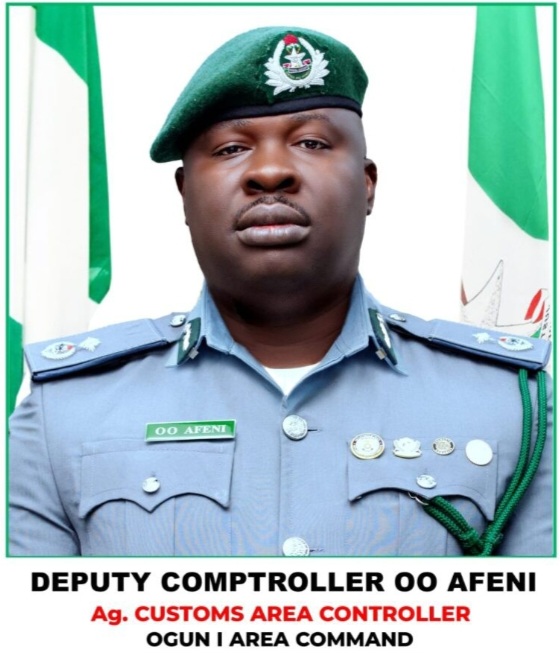
History often reserves its finest tributes for leaders who build people rather than monuments. Their legacy is measured not by applause, but by the quality of the institutions they leave behind. In the Nigeria Customs Service, Ogun I Area Command, Deputy Controller Olukayode Afeni has steadily emerged as one of those rare public officers whose influence is becoming impossible to ignore.
Eight months after assuming office as Acting Customs Area Controller, Afeni’s story can no longer be told merely through statistics of seizures, revenue generation or anti-smuggling victories. The more profound narrative lies beneath the figures: the deliberate construction of a command culture rooted in discipline, loyalty, professionalism and an unwavering commitment to national service.
Indeed, while Customs operations are often measured in intercepted contraband and revenue remittances, seasoned observers understand that the true test of leadership is the quality of institution a commander leaves behind. It is one thing to lead a successful command; it is quite another to build officers capable of sustaining excellence long after the commander has departed.
This is where what many have begun to describe as the “Afeni Effect” becomes particularly striking. His leadership philosophy appears anchored on a simple but powerful conviction—that the effectiveness of any enforcement agency begins with the character of the men and women who wear its uniform. By insisting on ethical conduct, teamwork, accountability and rewarding exceptional performance, Afeni is gradually embedding professionalism into the DNA of Ogun I Command.
That culture is especially significant given Ogun I’s strategic position along one of Nigeria’s most challenging border corridors. It is a terrain where smugglers constantly innovate, where commercial interests collide with national priorities, and where officers are routinely confronted with temptations capable of compromising even the most experienced personnel. In such an environment, discipline is not merely desirable; it is indispensable.
Recent operations provide compelling evidence of this transformation. The seizure of 2,547 parcels of cannabis, alongside foreign rice and other prohibited items, was more than an anti-smuggling success story. It was a testament to the integrity of officers who chose duty over inducement. Their refusal to compromise under pressure speaks volumes about a command increasingly defined by ethical resilience rather than operational opportunism.
Equally noteworthy was the seamless collaboration with the National Drug Law Enforcement Agency in the lawful transfer of the seized cannabis. The operation underscored an important truth about modern Customs administration: professionalism does not end at interception. It extends to proper documentation, chain-of-custody procedures, inter-agency cooperation and strict adherence to due process.
The same commitment to national responsibility was evident in the interception and transfer of four live pangolins to relevant wildlife authorities. In preserving endangered species from traffickers, Customs officers were not merely enforcing the law; they were protecting Nigeria’s ecological heritage and contributing to the global fight against wildlife crime.
Then came the recovery of two antique artefacts dating back to the 19th century and their handover to the National Museum in Abeokuta. In one operation, Ogun I demonstrated that Customs is not only a guardian of borders but also a custodian of history. The message was unmistakable: the Service has responsibilities that extend far beyond checkpoints and warehouses.
Collectively, these actions point to an emerging doctrine under Afeni’s watch—one that views Customs officers as defenders of the nation’s economic interests, public health, environmental sustainability and cultural identity. It is a broader and more sophisticated understanding of public service.
Yet, perhaps the most enduring aspect of the Afeni legacy remains largely invisible to the public eye: his investment in people. By recognising officers who distinguish themselves under difficult circumstances, he has created a powerful incentive structure within the command. It reinforces the idea that competence is rewarded, integrity matters and excellence will never go unnoticed.
For younger officers, Ogun I is increasingly becoming an informal academy of leadership. It is here that Afeni’s philosophy aligns seamlessly with the reform agenda of , whose tenure has consistently championed professionalism, institutional integrity and capacity building across the Nigeria Customs Service.
The Customs Service of tomorrow will require officers capable of balancing operational toughness with strategic thinking, stakeholder engagement and sound ethical judgment. Such qualities are not acquired overnight; they are cultivated over time through deliberate mentorship and exposure to responsible leadership.
In that regard, Ogun I is evolving into something greater than an enforcement command. It is becoming a proving ground for future leaders of the Service. For leadership experts, this may well be the ultimate measure of command: not the volume of orders issued, but the number of capable officers produced.
The Afeni Effect, therefore, transcends one officer and one tenure. It is a reminder that discipline without professionalism breeds rigidity; loyalty without institutional values breeds personal allegiance; and enforcement without mentorship produces only temporary victories.
However, when discipline, loyalty, accountability and professional excellence are woven together with purpose, the result is a resilient institution capable of weathering the uncertainties of tomorrow.
As Ogun I continues to confront evolving smuggling patterns and increasingly sophisticated criminal networks, the question is no longer whether the command will record more seizures or surpass revenue targets. The more important question is whether the culture being built today will endure for years to come.
If current indicators are anything to go by, Deputy Comptroller Olukayode Afeni is already crafting an answer. His most enduring legacy may not be found in annual reports or seizure statistics, but in the calibre of officers who will someday lead the Nigeria Customs Service.
And in public service, there can be no greater monument than that.
ADVERTISEMENTS