Lobbying: Tinubu, Atiku’s $10.2m US Spending Sparks Outcry


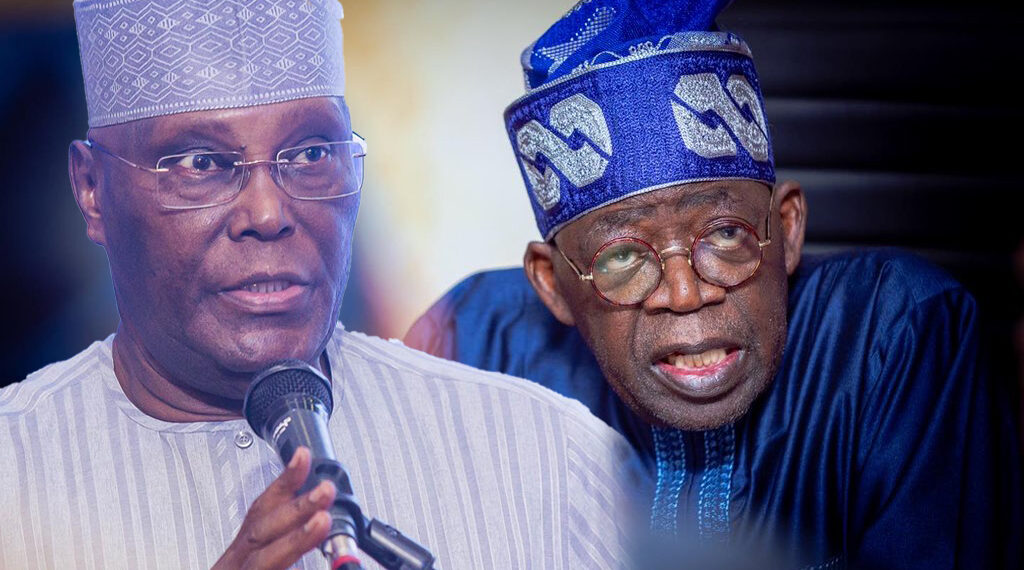
Collage of Atiku Abubakar and Bola Tinubu
By Frontline Reporters
Fresh controversy has erupted over more than $10 million reportedly committed to lobbying activities in the United States by the camps of President Bola Ahmed Tinubu and former Vice-President Atiku Abubakar, with critics questioning whether the expenditure represents the best use of resources amid Nigeria’s economic difficulties.
Publicly disclosed filings under the United States Foreign Agents Registration Act, FARA, indicate that the engagements are worth about $10.2 million. At an exchange rate of approximately N1,400 to the dollar, the amount translates to about N14.28 billion.
The figure has triggered a striking opportunity-cost debate. At N250,000 per intervention, N14 billion could theoretically provide financing for about 56,000 microenterprises. At N500,000 per beneficiary, it could support 28,000 businesses, while N1 million each would reach 14,000 enterprises. The calculations are illustrative and do not suggest that every beneficiary would automatically establish a sustainable business.
The more fundamental question, however, is what such an amount could achieve if deployed domestically through carefully structured financing, education, healthcare, infrastructure or other productive interventions.
Washington lobbying
The Federal Government’s engagement with Washington-based DCI Group dates to December 2025. Under the agreement, the firm was retained to help communicate Nigeria’s policies and actions to US policymakers, particularly concerning the protection of Christian communities and continued American support for Nigeria’s counter-terrorism efforts.
The contract reportedly provides for a monthly retainer of $750,000, with the initial six-month engagement valued at $4.5 million. An automatic renewal could take the total commitment to $9 million, while Nigeria paid $4.5 million upfront for the first six months.
The government’s decision came amid increased scrutiny of Nigeria’s security situation in Washington and concerns over the country’s international image. Its stated objectives are therefore diplomatic and security-related, meaning the value of the engagement cannot be judged solely by the amount spent.
Atiku, meanwhile, engaged Washington-based Von Batten-Montague-York, L.C. early this year under a 12-month agreement valued at $1.2 million.
US Department of Justice filings indicate that the engagement was designed, among other things, to strengthen Atiku’s access to US policymakers and counter narratives associated with the Nigerian government.
The filing also indicated that the firm would facilitate contacts with members of Congress and executive-branch officials while providing strategic advice on policy positioning.
In July, reports emerged that the firm had begun circulating historical US Department of Justice records relating to a 1993 drug-trafficking asset-forfeiture case linked to Tinubu among members of the Trump administration, Congress and senior congressional staff.
The opportunity cost
Taken together, the two engagements amount to about $10.2 million, or approximately N14.28 billion at N1,400 to the dollar.
That figure becomes significant when viewed against Nigeria’s persistent financing gap for micro, small and medium-sized enterprises.
The World Bank has identified MSMEs as a major pillar of Nigeria’s economy, accounting for most businesses, a substantial share of GDP and a large proportion of employment. Yet access to formal credit remains severely limited.
The World Bank’s subsequent financing support for Nigeria’s MSMEs underscores the importance of expanding access to capital, enabling businesses to invest, grow and create employment.
The N14 billion could also have been deployed through credit guarantees, concessional lending, infrastructure support, technical assistance or targeted interventions designed to improve the survival rate of small businesses.
Education alternative
Education provides another illustration of the opportunity cost.
If the amount were channelled through the Nigerian Education Loan Fund, NELFUND, it could potentially support the tuition and upkeep of a large number of students.
For example, using the cited Lagos State University fee figures, N14 billion would theoretically cover the annual tuition of more than 155,000 students paying N90,000 each. At N190,000 per student, it could cover tuition for about 73,684 students.
Using NELFUND’s cited monthly upkeep allowance of N20,000, the same N14 billion could provide one month’s allowance to 700,000 students, or a full 12-month allowance to roughly 58,000 students.
At Olabisi Onabanjo University, where cited tuition fees range from N190,000 to N350,000, the same sum could cover the fees of tens of thousands of students, depending on the category.
Again, these figures are not proposals or evidence that the money would necessarily be transferred in such a manner. They simply demonstrate the scale of the resources involved.
Jobs and small businesses
Nigeria’s labour-force data further highlights the importance of self-employment and household businesses.
According to cited National Bureau of Statistics data, 66.9 per cent of respondents in the referenced sample reported working in their own business or farming activity, while 20.2 per cent said they helped in a household business.
Against this background, critics argue that every major expenditure should be assessed not only by its immediate purpose but also by what alternative economic opportunities may have been sacrificed.
An economic expert, who spoke on condition of anonymity, described the lobbying expenditure as difficult to justify at a time when communities across Nigeria continue to face infrastructure deficits, unemployment and inadequate basic services.
He also questioned the practice of exporting domestic political disputes to foreign capitals, warning that such campaigns could have reputational implications for the country.
Accountability question
Executive Director of the Rule of Law and Accountability Advocacy Centre, Okechukwu Nwanguma, said the fundamental issue was opportunity cost.
“In a country where millions are struggling with unemployment, inadequate healthcare, deteriorating schools, insecurity and collapsing infrastructure, every billion naira of public money spent on lobbying abroad must be justified against what that money could have achieved at home,” he said.
Nwanguma, however, drew a distinction between Atiku’s expenditure and the Federal Government’s.
According to him, a politician spending legitimately acquired private funds on lobbying raises questions of disclosure and compliance with applicable laws, whereas expenditure involving taxpayers’ money requires a much higher level of transparency.
He said the government should disclose who was paid, how much was paid, the purpose of the expenditure, the procurement process and the measurable results expected.
“You cannot repeatedly tell Nigerians that there is no money while billions are available for expenditures whose public value has not been convincingly demonstrated,” he said.
Does lobbying pay?
Supporters of the government’s expenditure could argue that lobbying produces benefits that cannot easily be measured in naira.
For the Federal Government, access to Washington policymakers could potentially influence Nigeria’s diplomatic standing, security cooperation, foreign policy relationships and engagement with American institutions.
For Atiku, the objective is primarily political and reputational. A successful lobbying campaign could improve his access to American policymakers or influence perceptions of him abroad.
That makes a direct comparison between lobbying expenditure and business financing inherently imperfect.
The central question, however, remains one of capital allocation: does the expected benefit justify the amount committed when the same resources could address pressing domestic needs?
Investment banker and economist Bismarck Rewane has repeatedly stressed productivity, investment and the operating environment as critical to Nigeria’s economic prospects.
He has identified power, agriculture, manufacturing, fintech and telecommunications among sectors capable of driving productivity, while noting that SMEs are particularly vulnerable to unreliable electricity and high operating costs.
The implication is that even if N14 billion were redirected towards job creation, simply distributing the money would not be enough.
A more strategic deployment—through credit guarantees, infrastructure, technical support, affordable financing and market access—could potentially generate a more durable economic impact.
Ultimately, the controversy is not simply about whether Nigeria should lobby Washington.
It is about what Nigerians should reasonably expect in return for every dollar—or naira—committed to such activities, particularly when the same resources could potentially be deployed to create businesses, support students, strengthen infrastructure and improve livelihoods at home.
ADVERTISEMENTS