Outrage as EFCC Freezes Osun Government Account Ahead of Governorship Poll

***Why we froze account — EFCC
BY FRONTLINE REPORTERS
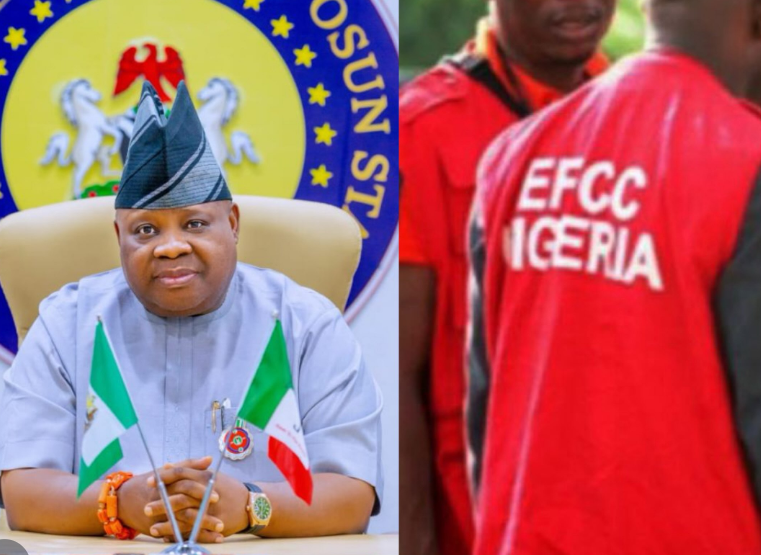
A fresh political storm has erupted in Osun State following the decision of the Economic and Financial Crimes Commission (EFCC) to place a post-no-debit restriction on a state government bank account, a move that has sparked widespread outrage from Governor Ademola Adeleke, opposition parties, legal practitioners and other stakeholders just days before the August 15 governorship election.
Governor Adeleke condemned the action as unconstitutional and an abuse of the rule of law, insisting that the anti-graft agency acted without lawful justification. He disclosed that he had directed the state’s Attorney-General and Commissioner for Justice to immediately challenge the decision before the Federal High Court, describing the restriction as a dangerous interference capable of disrupting governance and essential public services.
Documents sighted by journalists indicated that the EFCC, in a letter dated August 5, 2026, instructed a first-generation commercial bank to place a post-no-debit restriction on one of the Osun State Government’s accounts. The commission cited provisions of the EFCC Act, 2004, and the Money Laundering (Prevention and Prohibition) Act as the legal basis for its directive.
Addressing journalists in Osogbo, Governor Adeleke challenged EFCC Chairman Ola Olukoyede to publicly explain the rationale behind the action and provide evidence to justify the freezing of the state’s account. He argued that the decision undermines constitutional governance and warned that such actions could erode public confidence in Nigeria’s democratic institutions.
Backing the governor’s position, the Osun State Attorney-General and Commissioner for Justice, Mr. Oluwole Jimi-Bada (SAN), maintained that the EFCC lacks constitutional authority to freeze a state’s statutory account without due judicial process. He stressed that the affected account contains public funds earmarked for salaries, pensions, healthcare, education, security and other critical government obligations, insisting that any restriction on such funds should only be ordered by a court of competent jurisdiction.
However, the EFCC defended its action, saying it was compelled to intervene after investigators allegedly uncovered suspicious movements of public funds while probing the Osun State Government over the alleged diversion of about ₦11 billion from Ecology Funds, Intervention Funds and allocations from the Federation Account Allocation Committee (FAAC). According to the commission, the investigation began in March 2026 and had already involved interviews with several state officials, including the Accountant-General.
In a statement issued by its Head of Media and Publicity, Mr. Dele Oyewale, the EFCC said investigators observed what it described as “huge transfers” from government accounts into several corporate entities beginning on August 2, prompting the immediate freezing of the account to prevent further movement of funds. The commission insisted that the action was purely preventive, lawful and unrelated to the forthcoming governorship election, emphasizing that it has a statutory responsibility to safeguard public funds and ensure accountability.
The commission further disclosed that several state governments are currently under financial scrutiny, stressing that its operations are guided solely by law and national interest rather than political considerations. It urged Nigerians to disregard what it described as attempts to politicise its investigative activities.
The EFCC’s decision nevertheless triggered sharp criticism from political parties. The Accord Party alleged that the freezing of the account was designed to weaken the Adeleke administration ahead of the governorship election and vowed to challenge the action in court. Similarly, the African Democratic Congress (ADC) accused the Federal Government of deploying federal institutions as political instruments to influence the electoral process, claiming that withholding funds meant for governance would ultimately hurt ordinary residents rather than political actors.
Several senior lawyers also questioned the timing and legality of the action. Senior Advocate of Nigeria, Kunle Edun, argued that freezing a state’s operational account so close to an election could effectively cripple government activities and send the wrong democratic signal. Other legal practitioners, including Chukwuma Omezie, Evans Ufeli, Abdullahi Musa and Bartholomew Ojonugwa, urged strict adherence to constitutional safeguards, maintaining that such extraordinary measures should only follow judicial authorization and transparent legal procedures to avoid creating the impression of political interference.
Meanwhile, the political controversy widened as the Osun State chapter of the All Progressives Congress (APC) called on the EFCC and the Independent Corrupt Practices and Other Related Offences Commission (ICPC) to investigate allegations that the Adeleke administration was using public funds for vote-buying through the payment of ₦20,000 to workers and residents. The state government dismissed the allegation, explaining that the payments were part of its existing palliative programme introduced to cushion the economic hardship faced by civil servants and were not connected to the forthcoming election.
With barely days to the governorship election, the legal battle over the freezing of the state’s account is expected to intensify, as both the Osun State Government and the EFCC prepare to defend their positions in court. The outcome could have significant legal and political implications, not only for the state but also for the broader debate on the limits of federal investigative powers, the doctrine of constitutional federalism and the conduct of public institutions during election periods.
ADVERTISEMENTS